Normal Labour Definition Stages Physiology Management and Clinical Features
Below is a **concise yet complete, SEO-friendly medical reference** on **Normal Labour**, structured with clear **H1–H3 headings** and exam-oriented clarity.
---
# **Normal Labour**
## **Definition of Normal Labour**
Normal labour is a **physiological process** in which a **term pregnancy (37–42 weeks)** culminates in the **spontaneous onset of labour**, resulting in **vaginal delivery of a single, live fetus in vertex presentation**, followed by expulsion of the placenta, **without maternal or fetal complications**.
---
## **Criteria of Normal Labour**
Normal labour fulfills all of the following:
* **Gestational age:** 37–42 weeks
* **Onset:** Spontaneous
* **Presentation:** Vertex (cephalic)
* **Number of fetus:** Singleton
* **Progress:** Regular uterine contractions with progressive cervical dilatation
* **Mode of delivery:** Vaginal, without operative intervention
* **Outcome:** Healthy mother and baby
---
## **Physiology of Normal Labour**
Labour is initiated by a complex interaction of:
* **Hormonal factors:** ↑ Estrogen, ↓ Progesterone dominance, ↑ Prostaglandins, ↑ Oxytocin receptors
* **Uterine activity:** Coordinated, rhythmic contractions starting from fundus
* **Cervical changes:** Effacement and dilatation due to collagen remodeling
* **Fetal contribution:** Fetal HPA axis activation and cortisol release
---
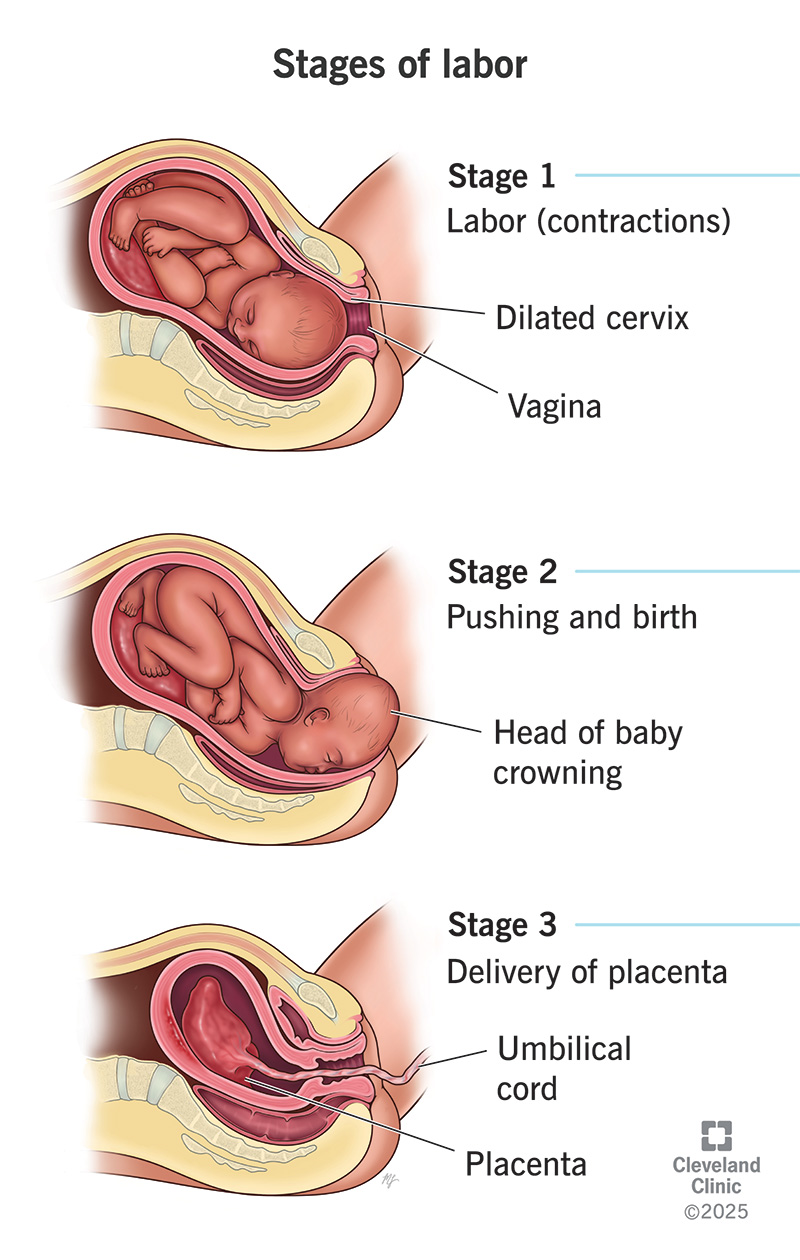
## **Stages of Normal Labour**
### **First Stage of Labour**
**From onset of true labour pains to full cervical dilatation (10 cm)**
#### Latent Phase
* Cervical dilatation: 0–3/4 cm
* Contractions: Mild, irregular
* Duration:
* Primigravida: up to 8–12 hours
* Multigravida: shorter
#### Active Phase
* Cervical dilatation: 4–10 cm
* Contractions: Regular, strong, 3–5 per 10 minutes
* Rate of dilatation:
* Primigravida: ~1 cm/hour
* Multigravida: ~1.5 cm/hour
---
### **Second Stage of Labour**
**From full dilatation to delivery of the fetus**
* Duration:
* Primigravida: ≤2 hours (≤3 hours with epidural)
* Multigravida: ≤1 hour
* Mechanism of labour occurs:
* Engagement
* Descent
* Flexion
* Internal rotation
* Extension
* Restitution and external rotation
* Expulsion
---
### **Third Stage of Labour**
**From delivery of fetus to expulsion of placenta**
* Duration: ≤30 minutes
* Placental separation mechanisms:
* Schultze (central separation)
* Duncan (marginal separation)
* Managed actively to prevent postpartum hemorrhage
---
## **Mechanism of Normal Labour (Vertex Presentation)**
1. Engagement
2. Descent
3. Flexion
4. Internal rotation
5. Extension
6. Restitution
7. External rotation
8. Expulsion
---
## **Signs of True Labour**
* Regular, painful uterine contractions
* Progressive cervical effacement and dilatation
* Show (blood-stained mucus)
* Descent of presenting part
---
## **Monitoring in Normal Labour**
* **Maternal:** Pulse, BP, temperature, uterine contractions
* **Fetal:** Fetal heart rate monitoring
* **Progress:** Partograph assessment of cervical dilatation, descent, and contractions
---
## **Management Principles of Normal Labour**
* Supportive care and reassurance
* Adequate hydration and nutrition
* Pain relief (non-pharmacologic or pharmacologic)
* Asepsis and bladder care
* Continuous monitoring for deviations from normal
---
## **Outcome of Normal Labour**
* Vaginal birth without complications
* Minimal maternal morbidity
* Healthy neonate with good Apgar score
---
## **Clinical Importance**
* Benchmark for identifying **abnormal labour patterns**
* Essential for **obstetric exams**, labour ward practice, and safe maternal care
* Basis for using **partograph** and deciding interventions
---
If you want, I can next provide:
* **SEO title, meta description, and keywords**
* **Abnormal labour comparison**
* **Partograph-based exam notes**
* **MCQs or case-based questions in HTML/CSS/JS (single file, modern UI)**
Normal Labour – Case Based MCQs
Hard exam-oriented questions | Obstetrics