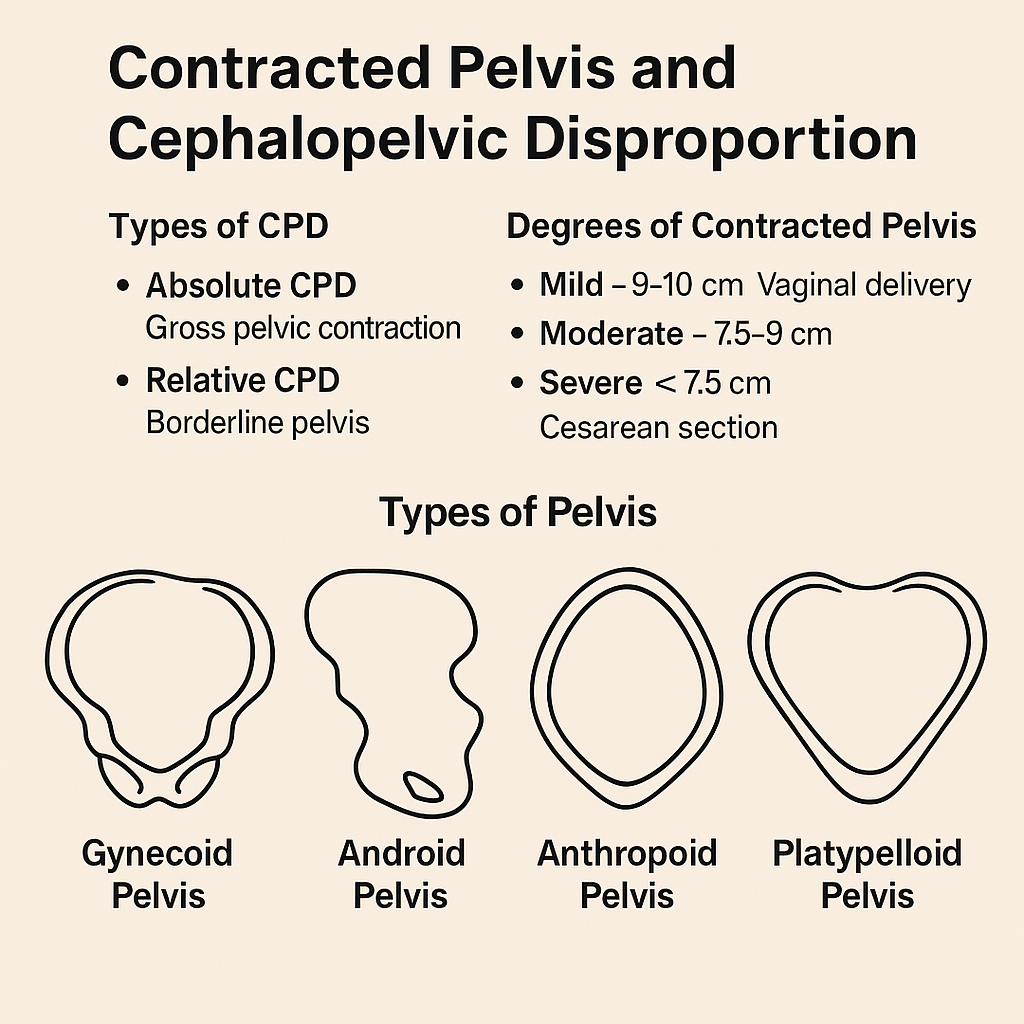
Contracted Pelvis and Cephalopelvic Disproportion Types Diagnosis Management
Below is a **concise yet complete, exam-oriented and SEO-friendly medical reference** covering **Contracted Pelvis, Cephalopelvic Disproportion (CPD), and Types of Pelvis**.
Structured with **H1–H4 headings**, keyword-rich language, and clear clinical flow. **No images included**, as requested.
---
# Contracted Pelvis and Cephalopelvic Disproportion: Types, Diagnosis and Management
## Introduction
**Contracted pelvis** and **cephalopelvic disproportion (CPD)** are major causes of **obstructed labor**, **prolonged labor**, and **operative delivery**. Understanding **pelvic anatomy**, **pelvic types**, and **fetal–pelvic relationships** is essential for safe obstetric practice.
---
## Contracted Pelvis
### Definition
A **contracted pelvis** is a pelvis in which **one or more pelvic diameters are reduced** below normal, interfering with the **descent and delivery of the fetus**.
---
### Causes of Contracted Pelvis
#### Developmental Causes
* Congenital pelvic abnormalities
* Malnutrition during childhood
* Rickets and osteomalacia
#### Acquired Causes
* Pelvic fractures with malunion
* Tuberculosis of bones
* Spinal deformities (kyphosis, scoliosis)
* Previous pelvic surgery
---
### Classification of Contracted Pelvis
#### 1. Anatomical Contracted Pelvis
* **True contraction** of one or more diameters
* Diagnosed by **pelvimetry**
#### 2. Functional Contracted Pelvis
* Pelvic diameters normal
* Obstruction due to:
* Large fetus
* Malposition or malpresentation
* Deflexed fetal head
---
### Degrees of Contracted Pelvis (Based on Obstetric Conjugate)
| Degree | Obstetric Conjugate | Clinical Significance |
| -------- | ------------------- | ------------------------- |
| Mild | 9–10 cm | Vaginal delivery possible |
| Moderate | 7.5–9 cm | Trial of labor |
| Severe | <7.5 cm | Cesarean section |
---
## Cephalopelvic Disproportion (CPD)
### Definition
**Cephalopelvic disproportion** occurs when the **fetal head is too large** or the **maternal pelvis too small** to allow vaginal delivery.
---
### Types of CPD
#### 1. Absolute CPD
* Gross pelvic contraction
* Vaginal delivery **impossible**
#### 2. Relative CPD
* Borderline pelvis
* Delivery depends on:
* Fetal head molding
* Position and attitude
* Strength of uterine contractions
---
### Causes of CPD
#### Maternal Factors
* Contracted pelvis
* Pelvic tumors
* Short stature
#### Fetal Factors
* Macrosomia
* Hydrocephalus
* Occipitoposterior position
* Deflexed head
---
### Clinical Features of CPD
* Failure of head engagement
* Prolonged labor
* Cervical dystocia
* Increasing caput and molding
* Maternal exhaustion
* Fetal distress
---
### Diagnosis of CPD
#### Antenatal Assessment
* History of difficult labor
* Clinical pelvimetry
* Ultrasound for fetal weight
#### Intrapartum Diagnosis
* Lack of descent despite good contractions
* Non-progress of labor
* Rising Bandl’s ring
---
### Management of CPD
#### Antenatal
* Identify high-risk cases
* Plan mode of delivery
#### Intrapartum
* **Trial of labor** in selected cases
* Continuous maternal and fetal monitoring
#### Definitive Management
* **Cesarean section** for:
* Absolute CPD
* Failed trial of labor
* Fetal distress
---
## Types of Pelvis (Caldwell–Moloy Classification)
### 1. Gynecoid Pelvis
* Most favorable for vaginal delivery
* Rounded inlet
* Wide subpubic angle
* Straight side walls
---
### 2. Android Pelvis
* Male-type pelvis
* Heart-shaped inlet
* Narrow mid-pelvis
* Common cause of **arrest of descent**
---
### 3. Anthropoid Pelvis
* Oval inlet (anteroposterior diameter increased)
* Occipitoposterior position common
* Vaginal delivery usually possible
---
### 4. Platypelloid Pelvis
* Flattened pelvis
* Wide transverse diameter
* Narrow anteroposterior diameter
* Engagement delayed
---
## Comparison of Pelvic Types
| Pelvic Type | Inlet Shape | Labor Outcome |
| ------------ | ------------ | ------------------ |
| Gynecoid | Round | Best |
| Android | Heart-shaped | Difficult |
| Anthropoid | Oval (AP) | OP common |
| Platypelloid | Flat | Engagement delayed |
---
## Clinical Importance
* Major determinant of **mode of delivery**
* Prevention of **obstructed labor**
* Reduces maternal and perinatal morbidity
* Essential for **exam preparation** and **clinical decision-making**
---
## Conclusion
**Contracted pelvis and CPD** remain critical challenges in obstetrics. Accurate **pelvic assessment**, understanding **pelvic types**, and timely intervention ensure safe outcomes for both mother and fetus.
---
### SEO Keywords (Comma-Separated)
contracted pelvis, cephalopelvic disproportion, CPD in obstetrics, types of pelvis, gynecoid pelvis, android pelvis, anthropoid pelvis, platypelloid pelvis, obstructed labor causes, pelvic contraction degrees, CPD diagnosis management
If you want, I can also provide **case-based MCQs**, **exam notes**, or a **single-file HTML CSS JS quiz** on this topic.