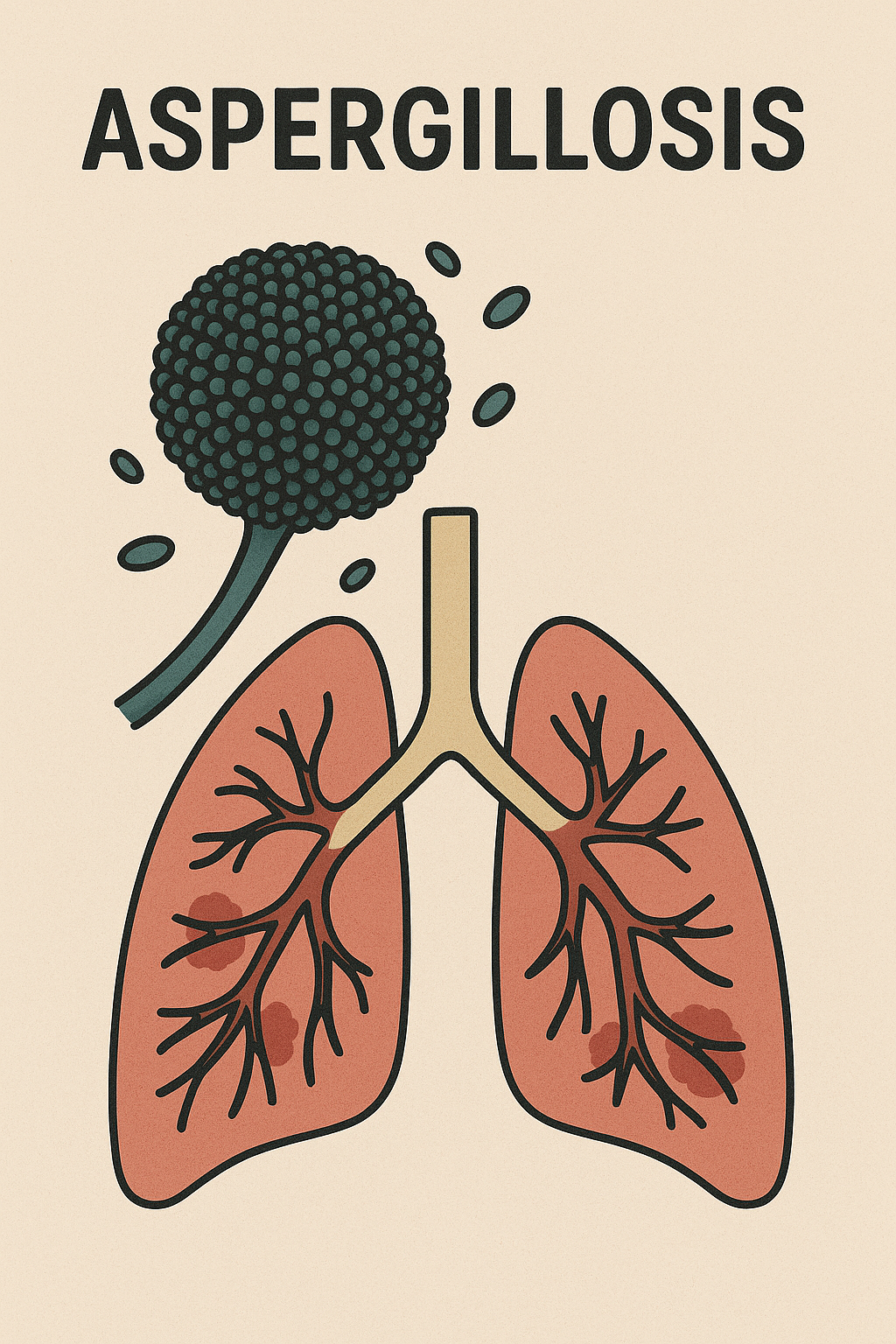
aspergillosis COMPLETE MEDICAL NOTE
---
# **ASPERGILLOSIS – COMPLETE MEDICAL NOTE**
---
## **1. DEFINITION**
Aspergillosis refers to a spectrum of diseases caused by **Aspergillus species**, most commonly **A. fumigatus**, affecting the lungs primarily but may disseminate in immunocompromised individuals. Disease spectrum includes:
1. **Allergic Bronchopulmonary Aspergillosis (ABPA)**
2. **Chronic Pulmonary Aspergillosis (CPA)**
3. **Aspergilloma (Fungal Ball)**
4. **Invasive Pulmonary Aspergillosis (IPA)**
5. **Disseminated Aspergillosis**
6. **Sinus Aspergillosis**
---
## **2. PATHOPHYSIOLOGY**
* **ABPA:** IgE-mediated hypersensitivity to Aspergillus colonizing bronchial tree → eosinophilia, mucus impaction, bronchiectasis.
* **CPA:** Chronic lung damage → cavity formation → slow progression ≥3 months with positive IgG.
* **Aspergilloma:** Fungal mass forms inside pre-existing lung cavity (TB, bronchiectasis, sarcoidosis).
* **IPA:** Hyphal invasion of lung tissue and blood vessels → tissue necrosis, infarction, hemoptysis → dissemination to brain, kidneys, skin.
---
## **3. RISK FACTORS**
### **For ABPA**
* Asthma (poorly controlled)
* Cystic fibrosis
* Atopy
### **For CPA / Aspergilloma**
* Post-TB cavities
* COPD
* Sarcoidosis
* Emphysema
* Immunosuppression (mild to moderate)
### **For IPA**
* Prolonged neutropenia
* Hematological malignancies
* Stem-cell / solid-organ transplantation
* Prolonged high-dose steroids
* AIDS (late stage)
* ICU + mechanical ventilation
* COVID-19 associated pulmonary aspergillosis (CAPA)
---
## **4. CLINICAL FEATURES**
### **ABPA**
* Recurrent wheezing
* Productive cough with brownish mucus plugs
* Fever
* Hemoptysis (mild)
* Central bronchiectasis
* Very high total IgE
* Asthma exacerbations
### **CPA**
* Chronic productive cough
* Weight loss
* Fatigue
* Low-grade fever
* Pleuritic chest pain
* Progressive cavitary lesions
### **Aspergilloma**
* Recurrent hemoptysis (can be massive)
* Cough
* Fungal ball visible on imaging
### **IPA**
* Fever not responding to antibiotics
* Pleuritic chest pain
* Cough
* Dyspnea
* Hemoptysis
* **CT halo sign**, **air-crescent sign**
* Multi-organ involvement if disseminated (brain, skin, kidneys, liver)
---
## **5. INVESTIGATIONS**
### **Blood**
* CBC: eosinophilia (ABPA), neutropenia (IPA)
* Serum IgE: >1000 IU/mL (ABPA)
* Aspergillus-specific IgE & IgG
* Galactomannan assay (BAL > Serum) for IPA
* β-D-glucan assay (positive in IPA)
### **Imaging**
* **Chest X-ray/CT**:
* ABPA → central bronchiectasis, “tram-track”, mucus impaction
* CPA → cavities, pleural thickening
* Aspergilloma → mobile fungal ball with air crescent
* IPA → halo sign, nodules, consolidation
### **Microbiology**
* BAL culture
* Histopathology showing acute-angle branching septate hyphae
---
## **6. DIFFERENTIAL DIAGNOSIS**
* Pulmonary TB
* Bronchiectasis (non-ABPA)
* Sarcoidosis
* Lung cancer (cavitary)
* Bacterial pneumonia
* Mucormycosis (broad, non-septate hyphae)
* Hypersensitivity pneumonitis
---
# **7. MANAGEMENT – COMPLETE**
---
## **A. ALLERGIC BRONCHOPULMONARY ASPERGILLOSIS (ABPA)**
### **First-line Treatment**
### **1. Oral Corticosteroids**
* **Prednisolone**
**Dose:**
* 0.5–1 mg/kg/day × 2 weeks
* Taper over 3–6 months
* **MOA:** Anti-inflammatory, suppress IgE-mediated hypersensitivity
* **PK:** Hepatic metabolism, t½ 2–3 hrs
* **ADR:** Hyperglycemia, hypertension, infection risk, osteoporosis
* **Monitoring:** blood glucose, BP, weight, IgE levels monthly
* **Counselling:** do not abruptly stop, warn hyperglycemia, infection symptoms
### **2. Antifungal (to reduce antigen burden)**
* **Itraconazole** 200 mg twice daily × 16 weeks
* **MOA:** inhibits ergosterol synthesis
* **ADR:** hepatotoxicity, GI upset
* **Monitoring:** LFT baseline + every 4 weeks
* **Interactions:** CYP3A4 (statins, warfarin)
---
## **B. CHRONIC PULMONARY ASPERGILLOSIS (CPA)**
### **1. Itraconazole**
* 200 mg twice daily × 6–12 months
* Same MOA/ADR as above
### **2. Voriconazole** (if itraconazole fails)
* **Dose:**
* Loading: 6 mg/kg IV q12h × 2 doses
* Maintenance: 4 mg/kg IV q12h OR 200 mg PO q12h
* **MOA:** inhibits 14-α-demethylase
* **PK:** nonlinear metabolism, hepatic
* **ADR:** visual disturbances, hepatotoxicity, photosensitivity
* **Monitoring:** trough levels, LFTs
* **Counselling:** avoid sunlight
### **3. Surgery**
* Indicated for localized disease or severe hemoptysis
---
## **C. ASPERGILLOMA**
### **Management**
* Observation if asymptomatic
* **Massive hemoptysis → Surgical resection**
* Oral antifungals generally ineffective
* Bronchial artery embolization temporary control
---
## **D. INVASIVE PULMONARY ASPERGILLOSIS (IPA) – LIFE-THREATENING**
### **FIRST-LINE: Voriconazole**
(complete details above)
### **ALTERNATIVES**
1. **Liposomal Amphotericin B**
* **Dose:** 3–5 mg/kg/day IV
* **MOA:** binds ergosterol → membrane pore formation
* **ADR:** nephrotoxicity, hypokalemia, hypomagnesemia
* **Monitoring:** renal function, electrolytes
* **Counselling:** hydration important
2. **Isavuconazole**
* **Dose:** 372 mg IV/PO q8h × 6 doses, then daily
* **ADR:** less QT effects, hepatotoxicity
* **Use:** renally impaired patients
3. **Combination (for refractory IPA)**
* Voriconazole + Echinocandin (caspofungin)
### **Supportive Care**
* Reversal of neutropenia (G-CSF)
* Reduce steroids
* ICU ventilation support
---
## **E. DISSEMINATED ASPERGILLOSIS**
* Treat as IPA + organ-specific therapy
* Neurosurgery for abscess if needed
---
# **8. MONITORING PARAMETERS**
* IgE levels (ABPA): expect 25–35% fall
* CT chest every 3–6 months (CPA/IPA)
* LFTs for azoles
* Renal function + electrolytes for Amphotericin B
* Voriconazole trough levels: 1–5 mcg/mL
---
# **9. PATIENT COUNSELLING POINTS**
* Avoid construction sites, soil exposure
* Use N95 mask if immunocompromised
* Report visual symptoms (voriconazole)
* Avoid sunlight (phototoxicity with voriconazole)
* Ensure adherence – prolonged therapy is essential
* Monitor for jaundice, dark urine (hepatotoxicity)
---
---
# **30 ASPERGILLOSIS CASE SCENARIOS**
---
## **1. ABPA in Asthma**
A 24-year-old asthmatic presents with recurrent wheezing, cough with brown mucus plugs, and very high IgE (2800 IU/mL). CT: central bronchiectasis.
**Diagnosis: ABPA**
**Management:** Prednisolone + itraconazole.
---
## **2. ABPA with Eosinophilia**
A 32-year-old woman with allergic rhinitis has eosinophils 1500/µL + worsening asthma. CT shows mucus impaction (“finger-in-glove”).
**Management:** Oral steroids + IgE monitoring.
---
## **3. ABPA in Cystic Fibrosis**
A 16-year-old CF patient has acute drop in lung function, fever, wheeze. Total IgE 1800 IU/mL.
**Management:** Prednisolone + itraconazole for 16 weeks.
---
## **4. Steroid-dependent Asthma with ABPA Relapse**
A patient with history of ABPA presents again with raised IgE by 40% from baseline.
**Management:** Restart steroids; evaluate for itraconazole failure.
---
## **5. Chronic Pulmonary Aspergillosis in Old TB Cavity**
A 45-year-old male treated for TB 3 years ago develops chronic cough, weight loss and cavitary thick-walled lesion. Aspergillus IgG positive.
**Diagnosis: CPA**
**Treatment:** Itraconazole 200 mg BID for 6–12 months.
---
## **6. CPA with Cavitary Lesions & Fatigue**
A smoker with COPD presents with 4-month cough and fatigue. CT: cavity with pleural thickening.
**Diagnosis:** CPA
**Management:** Oral itraconazole + 3-monthly CT.
---
## **7. CPA Not Improving on Itraconazole**
After 3 months of itraconazole, symptoms persist and drug level is subtherapeutic.
**Management:** Switch to voriconazole, therapeutic drug monitoring.
---
## **8. Aspergilloma with Mild Hemoptysis**
A 55-year-old man with past TB has recurrent mild hemoptysis. CT: mobile “fungal ball”.
**Management:** Observe; consider itraconazole only if symptomatic.
---
## **9. Massive Hemoptysis from Aspergilloma**
CT confirms a large aspergilloma in right upper lobe with active bleeding.
**Management:** Bronchial artery embolization → definitive surgical resection.
---
## **10. Invasive Aspergillosis in Neutropenia**
A 42-year-old AML patient on chemotherapy develops fever unresponsive to antibiotics. CT: halo sign. Galactomannan positive.
**Diagnosis: IPA**
**Treatment:** Voriconazole (first line).
---
## **11. IPA in Bone Marrow Transplant Patient**
A transplant recipient develops pleuritic chest pain and hemoptysis. CT halo sign.
**Management:** IV voriconazole + reduce immunosuppression.
---
## **12. ICU Patient with Ventilator-Associated IPA**
A 60-year-old ventilated patient develops worsening hypoxia. BAL galactomannan 3.0.
**Management:** Voriconazole + treat underlying sepsis.
---
## **13. Disseminated Aspergillosis – Brain Abscess**
A neutropenic patient develops seizures; MRI shows multiple ring-enhancing lesions.
**Management:** Voriconazole (excellent CNS penetration).
---
## **14. Disseminated Aspergillosis – Skin Lesions**
Painful necrotic papules in a leukemia patient. Biopsy: septate hyphae.
**Management:** IV voriconazole ± liposomal amphotericin B.
---
## **15. Disseminated Aspergillosis – Kidneys**
AKI with fungal invasion on biopsy.
**Management:** Voriconazole, consider amphotericin B if refractory.
---
## **16. COVID-Associated Pulmonary Aspergillosis (CAPA)**
A severe COVID patient on steroids develops worsening infiltrates and fever. BAL galactomannan positive.
**Management:** Voriconazole; minimize steroids.
---
## **17. CAPA with Rapid Hypoxia**
Patient worsens with extensive cavitations post-COVID.
**Management:** Switch to amphotericin B if no improvement on azoles.
---
## **18. Sinus Aspergillosis – Allergic Fungal Rhinosinusitis**
A 30-year-old allergic patient with chronic sinusitis, nasal polyps, eosinophilia. CT shows hyperdense sinus contents.
**Management:** Steroids + functional endoscopic sinus surgery (FESS).
---
## **19. Invasive Sinus Aspergillosis**
A diabetic patient with facial pain and black nasal eschars.
**Management:** Urgent debridement + IV voriconazole.
---
## **20. Aspergillus Keratitis**
Contact lens user with corneal ulcer unresponsive to antibacterials.
**Management:** Topical natamycin or voriconazole.
---
## **21. Aspergillus Endocarditis**
IV drug user with fever and negative blood cultures; echo shows vegetations.
**Management:** Amphotericin B + surgery.
---
## **22. Lung Transplant Patient – IPA**
Post-lung transplant day 30 develops cough, nodules on CT.
**Management:** Voriconazole + adjust immunosuppressants.
---
## **23. Solid-Organ Transplant – Liver**
Unexplained fever, pulmonary nodules, galactomannan positive.
**Management:** Voriconazole; consider echinocandin combo.
---
## **24. Severe Asthma with Suspected ABPA but Normal IgE**
Symptoms + bronchiectasis but IgE only mildly raised.
**Diagnosis:** Serologic ABPA variant
**Management:** Steroids + continue asthma therapy.
---
## **25. CPA with Hemoptysis in Emphysema**
Elderly smoker with CPA + intermittent hemoptysis.
**Management:** Antifungals + control COPD, consider embolization.
---
## **26. Aspergilloma in Sarcoidosis**
Sarcoid cavity filled with fungal ball, recurrent bleeding.
**Management:** Surgical resection.
---
## **27. IPA after Anti-TNF Therapy**
A patient on infliximab develops fever + nodules + pleuritic pain.
**Management:** Voriconazole; discontinue TNF blocker.
---
## **28. Post-ICU CPA**
A prior ICU patient with ARDS develops slowly progressive cavitary changes over months. IgG positive.
**Diagnosis:** Subacute invasive → CPA transition
**Management:** Oral itraconazole.
---
## **29. Aspergillus Tracheobronchitis**
Seen in ICU: pseudomembranes + ulceration in bronchi.
**Management:** Voriconazole IV.
---
## **30. Pediatric ABPA**
An 11-year-old with long-standing asthma, recurrent exacerbations, eosinophilia, IgE 2500 IU/mL.
**Management:** Prednisolone + pediatric dosing itraconazole.
---